

Category: Mindset & Mental Toughness · Read Time: 7–9 min · By: Payne to Success / ValorMedia
There is a version of you that never struggles. Never pushes. Never fails.
That version of you is also never growing.
Comfort is seductive. It whispers that you deserve rest, that things are fine enough, that the risk isn’t worth it. And in small doses, that voice is right — rest is necessary, contentment has value, and not every hill is worth dying on.
But somewhere along the way, comfort stops being a tool and starts being a trap. And most people don’t even notice until they look up five years later and wonder why nothing has changed.
This is about that trap — and how to get out of it.
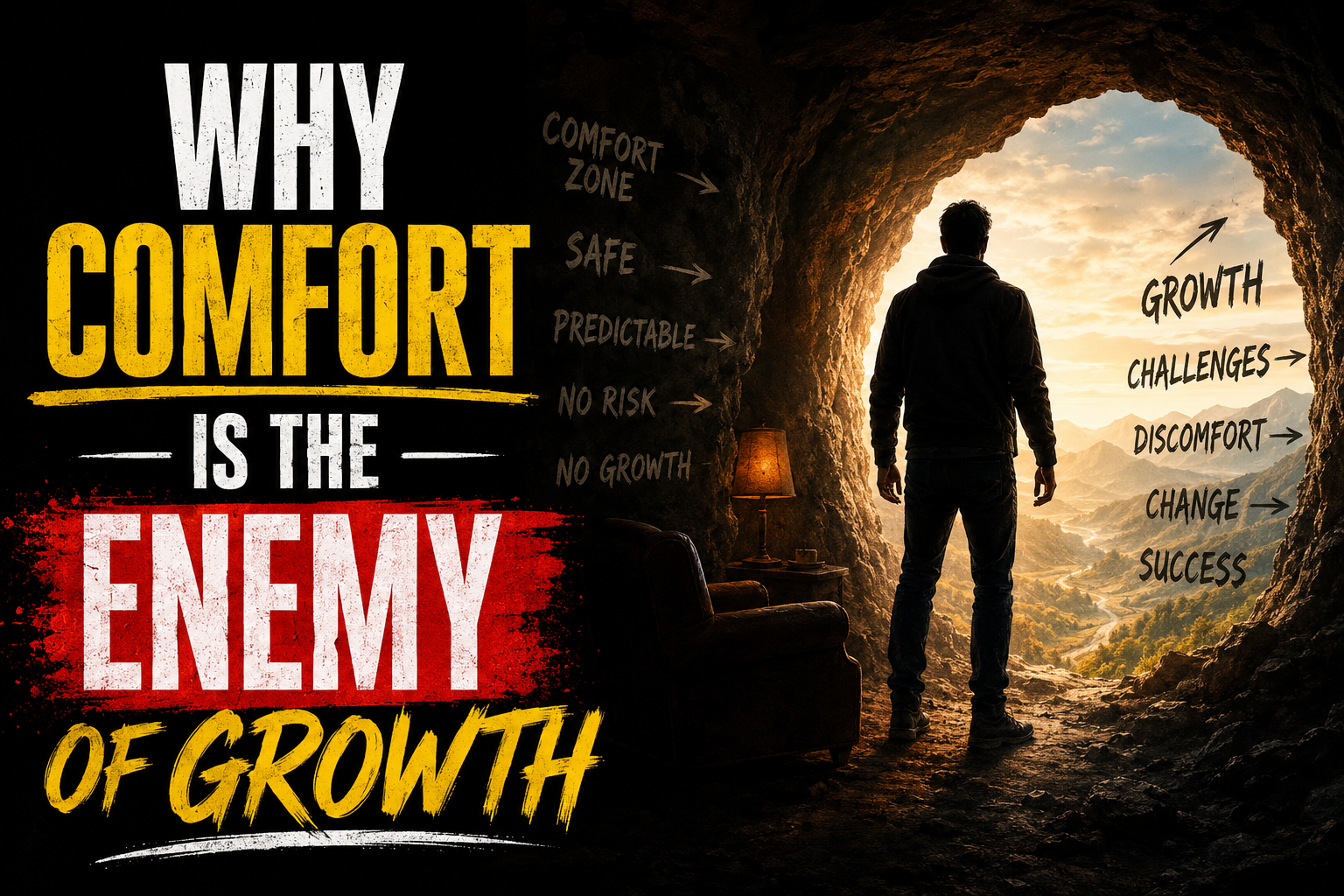
“The cave you fear to enter holds the treasure you seek.” — Joseph Campbell
What Comfort Actually Is
Comfort isn’t just laziness. That’s the misconception that makes it so hard to address. Comfort is a biological response. Your brain is wired to seek safety, conserve energy, and avoid pain. From an evolutionary standpoint, that instinct kept your ancestors alive.
The problem is that your brain cannot tell the difference between the kind of discomfort that kills you and the kind of discomfort that builds you.
Rejection from a job application. The first mile of a morning run. A difficult conversation with someone you love. The blank page before the first word of something new.
None of these will end your life. But your nervous system treats them like threats — and comfort is the escape route it offers every single time.
Psychologists call this the Yerkes-Dodson Law: performance and growth improve with arousal and challenge up to a certain point. Too little stimulation — too much comfort — and performance flatlines. You stop developing. You stop adapting. You plateau.
The Slow Death of Settling
Here’s what makes comfort so dangerous: it doesn’t feel like failure. It feels like stability.
You’re not falling apart. The bills are paid. Things are mostly fine. And that’s exactly the problem — “mostly fine” is the death sentence that comes with a smile.
When things are fine, you don’t have urgency. You don’t have hunger. You don’t have the pressure that forces you to find out what you’re actually made of.
The people who do extraordinary things are rarely the ones who had the easiest path. They’re the ones who had a reason — internal or external — to push past what felt comfortable. They learned to tolerate, and eventually embrace, the friction.
Settling doesn’t announce itself. It’s not a moment of decision. It’s a thousand small choices — to sleep in instead of train, to stay quiet instead of speak up, to stay in the job that feels safe instead of building the thing that scares you. Individually, each choice seems reasonable. Cumulatively, they define your ceiling.
“You don’t rise to the level of your goals. You fall to the level of your systems.” — James Clear
Why Growth Requires Discomfort — Not Sometimes, But Always
This isn’t motivational language. It’s biology.
Muscles grow through stress. They break down and rebuild stronger. Take away the stress and the growth stops — that’s not a metaphor, it’s physiology.
The same principle governs every other form of development. Mental toughness, emotional resilience, business skill, leadership ability — all of it is built the same way. You are exposed to something difficult. You adapt. You become capable of more than you were before.
That process is impossible without discomfort. Discomfort is not the obstacle to growth. Discomfort is the mechanism of growth.
Which means every time you retreat to comfort, you are not resting — you are refusing. You are telling your future self that today’s ease is worth more than tomorrow’s capability.
The Three Comfort Traps Most People Fall Into
1. Comfort Disguised as Preparation
You’re not ready yet. You need more time, more information, more certainty. So you research. You plan. You consume content about the thing instead of doing the thing.
This is one of the most sophisticated traps because it looks like productivity. But preparation without execution is just fear with good branding. At some point, you have to ship the thing, send the email, start the workout, have the conversation. No amount of planning eliminates the discomfort of beginning.
2. Comfort Disguised as Self-Care
Rest matters. Recovery is real. But there is a difference between strategic rest and avoidance wearing a wellness aesthetic.
If you’re consistently choosing the Netflix marathon over the hard conversation, the extra hour of sleep over the early workout, the comfortable silence over the accountability — and calling it “taking care of yourself” — it’s worth asking honestly: are you recovering, or are you hiding?
3. Comfort Disguised as Contentment
This one is the most convincing. You’ve convinced yourself — and maybe others — that you’re just grateful. Happy with what you have. Not chasing more.
And maybe that’s true. But there’s a meaningful difference between genuine gratitude and resigned acceptance. One comes from a place of fullness. The other comes from a place of fear — fear that trying and failing would be worse than never trying at all.
How to Start Getting Comfortable With Discomfort
The goal is not to eliminate discomfort. The goal is to change your relationship with it — to stop running from it automatically and start treating it as signal, not threat.
Here are five ways to start:
- Do the hard thing first. Each morning, identify the one task you are most resistant to. Do that first. Every time you start your day by moving toward discomfort, you train your brain to associate discomfort with momentum rather than avoidance.
- Small doses, consistently. You don’t need to burn your life down and start over. Take a cold shower. Introduce yourself to someone you don’t know. Say the thing in the meeting you normally keep to yourself. Small, repeated exposures to discomfort build tolerance over time.
- Name the fear specifically. Vague discomfort is harder to push through than named fear. Instead of “this feels bad,” try “I’m afraid this will fail and people will judge me.” Naming it gives you something concrete to act against.
- Reframe the sensation. Discomfort — the racing heart, the tightening chest — is physiologically almost identical to excitement. Your interpretation of that signal is a choice. Train yourself to read discomfort as evidence that something important is happening.
- Track your exposure. Keep a simple record of the uncomfortable things you did this week. Over time, this record becomes proof that you are someone who moves toward hard things — and that identity compounds.
The Version of You on the Other Side
Every version of you that you admire was built in discomfort.
The disciplined version. The confident version. The one who built something, survived something, became something. That person did not get there by finding comfort in the right circumstances. They got there by choosing to move when everything in them said to stop.
Comfort is not your enemy because it feels good. It’s your enemy because it convinces you that feeling good right now is more important than becoming who you are capable of being.
The gap between who you are and who you could be lives in the space you keep avoiding.
Step into it.
Ready to wear the mission?
Use code GETUP at ValorBuiltApparel.com — apparel built for people who choose growth over comfort. Every purchase supports a community of people who refuse to settle.
And if this hit home — subscribe to Payne to Success wherever you listen to podcasts. New episodes drop weekly.